
Overview
The Live Agent functionality feature in jtel Portal enhances makes call handling better by integrating using AI -powered live transcription, sentiment analysis, entity extraction, and real-time agent assistance. This feature enables to transcribe live calls, extract important information, analyze sentiment* and provide real-time help to agents. This feature helps supervisors and agents to process deal with conversations more efficiently with by using AI support.
Features
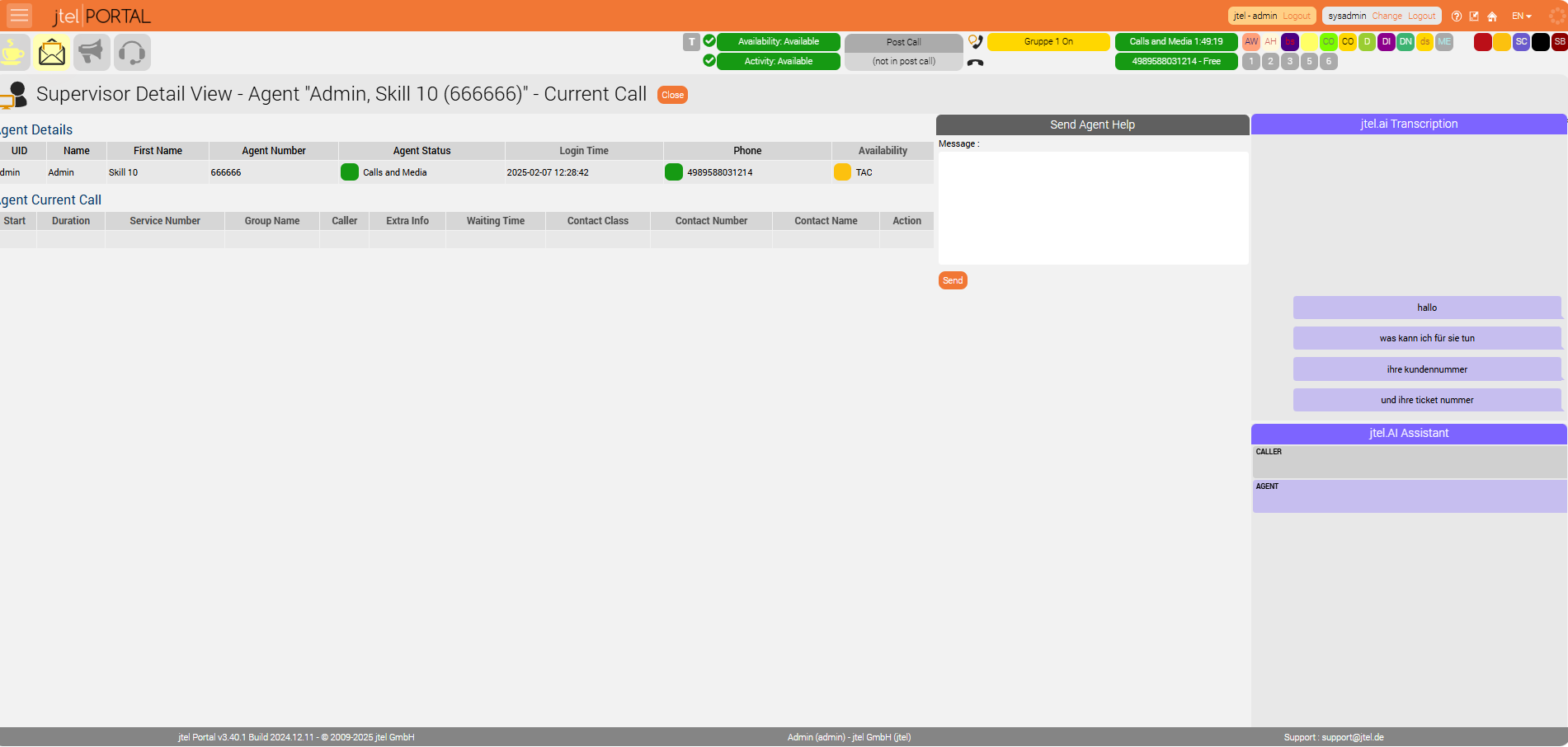
Live Transcription
Real-time transcription of ongoing calls using supported ASR (Automatic Speech Recognition) speech to text (STT) engines.
Displayed directly in Agent Home and Supervisor for both agents and supervisors.
...
A chain of AI modules can be attached to the transcription process, offering:
Sentiment Analysis: Detects emotions in conversations, displaying icons for happy, neutral, or angry tones.
Entity Extraction: Identifies useful data such as:
Automatic CRM or ticket system link generation based on customer or ticket numbers.
Suggested transaction codes related to the call.
Summary extraction at the end of the call.
- Transaction Code Suggestions: based on the conversation context.
- The AI can detect relevant transaction codes during the call.
- Suggested transaction codes are displayed to the agent in real-time.
- Sentiment Analysis*: Detects emotions in conversations, displaying icons for happy, neutral, or angry tones.
AI Pipeline Integration: Supports multiple AI models, including:
Microsoft Copilot
Existing chatbots
Custom AI solutions with REST API support.
Parallel AI Processing: Multiple AIs can process data simultaneously without delays.
...
In Client Master Data - Parameters. set AI Pipeline Configuration, After Call Pipeline Configuration and Transcription Provider
| Name | Value |
|---|---|
LiveAgent.AIPipeline.EndPoint | http://<server>:<port>/api/v1/aipipeline |
LiveAgent.AIPipeline.Input | { "endpoints": [ { "type": "suggestions", "url": "http://<server>:<port>/webhooks/rest/webhook", "input": { "sender": "%Service.StatisticsPartAID_%", "message": "$ai_pipeline_input" } }, { "type": "sentiment", "url": "http://<server>:<port>/api/v1/sentiment", "input": { "data": "$ai_pipeline_input" } } ]} |
LiveAgent.AfterCallPipeline.EndPoint | http://<server>:<port>/api/v1/aftercall |
LiveAgent.AfterCallPipeline.Input | { "endpoints" : [ { "type" : "summary", "url" : "http://<server>:<port>/api/v1/summary", "input" : $ai_pipeline_input } ], "respondTo" : { "host" : "%SERVER_IP_UDP_ADDRESS%", "port" : %ACD.UDP.Webserver.Port%, "message" : "NONCALL;AI_AFTERCALL_PIPELINE_RESULT;%QueueCheck.AgentDataID%;%Service.StatisticsPartAID_%;AI_PIPELINE_OUTPUT=$ai_pipeline_output" }} |
| # Instructions
|
| # Instructions
|
| # Instructions
|
| # Instructions
|
LiveAgent.Transcribe.Provider | EnderTuring.v2 (or Azure...) |
User Settings
Activate Live Agent functionality per user role:
...
Supervisors can see the agent’s current call, live transcription, and send direct messages to guide the agent during the call.
...
*Please note: Sentiment Analysis
Emotional states derived from conversation analysis (sentiment analysis) are considered ‘health-related data’. The use of artificial intelligence (AI) for sentiment (mood) analysis in telephone conversations in Germany is subject to one of the strictest and most complex legal frameworks in the world. The biggest legal hurdle arises from the actual purpose of the technology, determining the emotional tenor of a conversation. When an AI system recognizes and classifies emotions such as joy, frustration, fear or stress, it draws conclusions about the mental and psychological state of the speaker. This means that the processing falls into the most heavily protected data category of all. The path to lawful speech analysis is achieved through strategic planning and documented implementation in all areas, enabling a company to move from a position of high legal risk to one of reasonable compliance, thus enabling the innovative use of technology while preserving the fundamental rights to privacy and co-determination that are firmly anchored in German legislation.