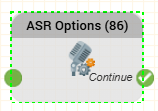
From release 3.47, the new IVR object ASR Options can be used to configure ASR behavior directly within a routing application.
The object allows the routing application to control:
The configured options apply to subsequent ASR operations and can be changed multiple times during the same call.
This makes it possible, for example, to use the client default ASR provider for one part of a routing application and switch to another provider for a later part of the same call.
The ASR Options object is available in the routing application editor and can be inserted before ASR objects whose behavior should be changed.
Example of the ASR Options object in a routing application.
The object provides the following configuration options:
The ASR Provider option can be used to override the ASR provider configured for the client.
Currently supported providers are:
If no ASR provider is selected, the existing client/default ASR configuration is used.
The selected provider remains active for subsequent ASR operations until it is changed by another ASR Options object.
The Voicebot Recording option controls whether the caller's Voicebot ASR utterances are recorded.
Voicebot recording can be:
When enabled, the recorded ASR utterances are stored in the client-specific Voicebot recording directory and are available from the Call Log.
The setting remains active until it is changed by another ASR Options object.
Voicebot ASR recording is independent from Live Agent call recording.
When Voicebot recording is enabled using the ASR Options object, the caller's Voicebot ASR utterances are recorded.
Live Agent transcription processes audio in real time and does not create a separate ASR recording.
Normal Live Agent call recording continues to be controlled independently by the existing ACD Group recording configuration.
Changing the Voicebot recording setting therefore does not affect Live Agent call recording.